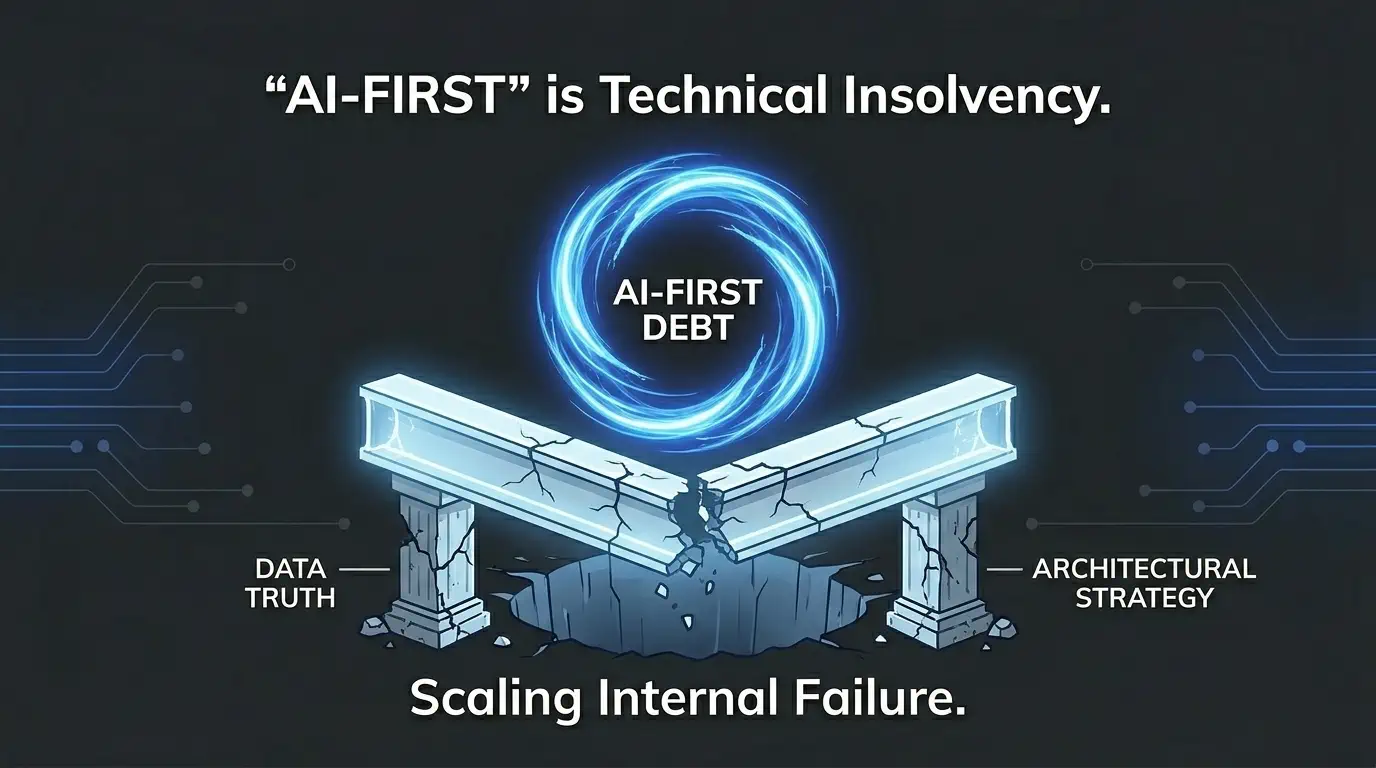


Why Your SEO Expert is Selling You Yesterday’s Trash

Summary
A technical exposé directed at business owners regarding the structural obsolescence of traditional SEO. This article differentiates between legacy click-based search and modern Generative Engine Optimization (GEO). It argues that current SEO retainer models are failing to resolve business entities for AI search and proposes a shift toward data-integrated infrastructure and semantic entity modeling.
The Current State of Failure
SEO is not AI optimization. SEO is a traffic-generation model built for a click-based internet that died when AI Overviews began answering queries natively. When your agency claims they are doing “AIO” while tethering you to keyword rankings and backlink counts, they are not innovating; they are simply stuffing noise into a black box to justify your monthly retainer. They are selling you a legacy tax on business growth, and they know it. And let’s be clear: this is partially on you. You were sold a fantasy because you wanted to believe that business growth could be automated away. But that fantasy is now bleeding your company dry.
The Myth of SEO Competence
I have spent 25 years as a CTO. I have built systems that ingest data at scale. I know how search engines work because I have seen the plumbing, not just the glossy front-end reports that your SEO agency sends you every month.
The SEO industry is currently engaged in a massive rebranding exercise. They are terrified. They see the shift toward zero-click AI search, where users get their answers without ever visiting a website, and they are scrambling to survive. Their response? Slapping the “AI” label onto the same link-farming, keyword-stuffing, and content-spinning tactics they’ve been peddling for a decade.
Anatomy of a Digital Ghost
Consider a mid-market B2B SaaS company I audited last month. They were paying an “elite” SEO firm $8,000 a month. The monthly reports were glowing: “Rankings for your primary keywords are up 15%! Domain Authority increased to 50! Traffic is trending up!”
The business owner felt great. Until I checked the actual business outcome.
- The Reality: While the SEO firm was “winning” at ranking for generic, high-volume keywords, the AI search engines and LLMs (like Perplexity and Gemini) were completely ignoring the site.
- The Impact: When a potential high-value client asked a complex, 20-word question to an AI assistant, the AI pulled its answer from a technical white paper by a competitor, a competitor who didn’t rank for “keywords,” but who had a properly structured, machine-readable knowledge graph.
- The Result: The SaaS company’s “traffic” was nothing but low-intent, accidental clicks. Meanwhile, their authority (the ability to be cited as a source by AI) was zero. They were paying $96,000 a year to be a ghost in the machine.
Exposing the Retainer Ruse
If you want to know if your SEO agency is bleeding you dry, look at their monthly report. It is a carefully curated fiction designed to keep you from asking the only question that matters: “Where is the revenue?”
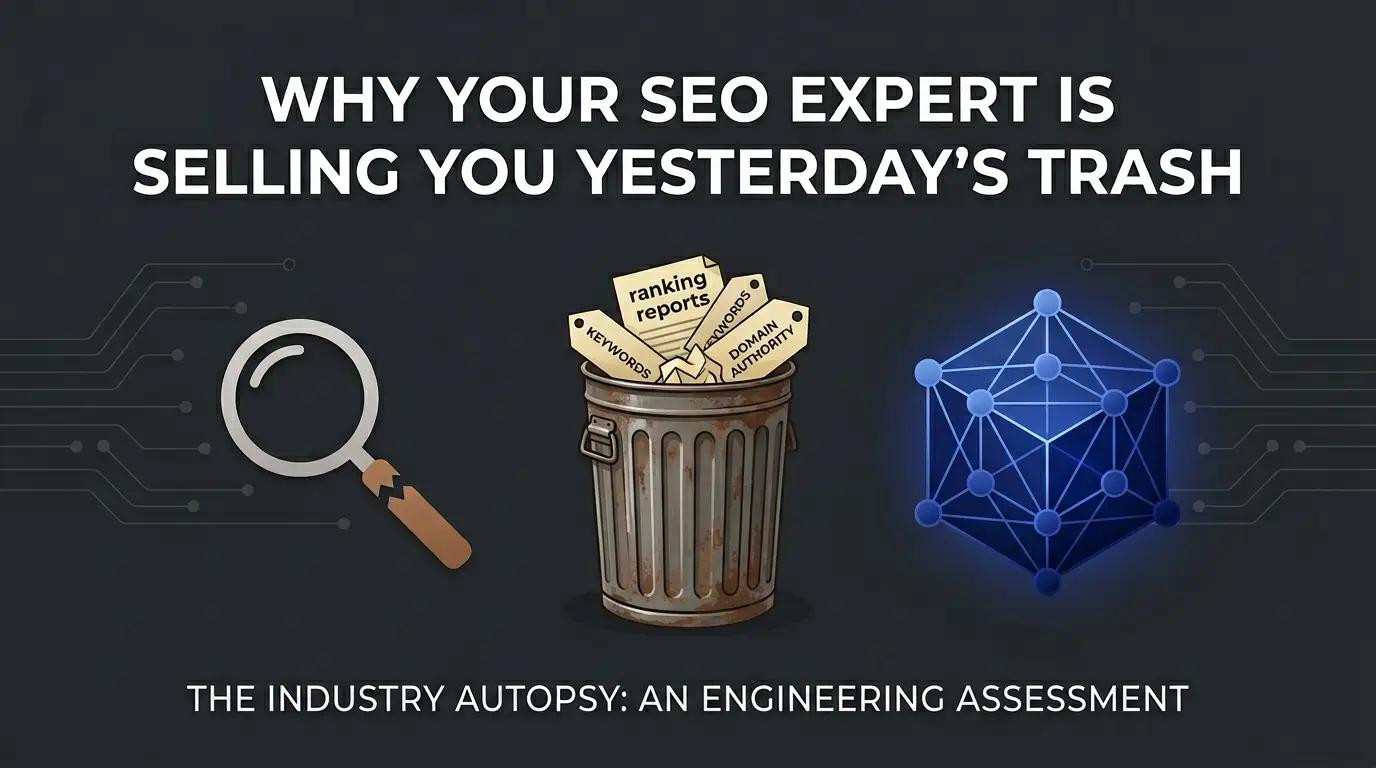
They provide “Ranking Reports” showing you are #1 for long-tail keywords that nobody searches for. They provide “Traffic Reports” that include bots, referrers, and accidental clicks, all bundled together as “Growth.” They do this because they know that if you saw the reality, that your Entity Relevance is stagnant and your Answer Engine Optimization is nonexistent, you would fire them immediately.
These agencies are not “behind the times.” They are unethical. They know that AI search is cannibalizing traditional SERPs, yet they continue to sell you the same “Ranking” packages because it is low-effort, high-margin, and highly scalable for them. They are treating your business capital as their own R&D budget, experimenting with outdated tactics on your dime while your brand’s actual digital authority decays in real-time. It is a parasitic business model, plain and simple.
| The “SEO” Hype | The AI Search Reality |
| “We are optimizing your keywords.” | “We are stuffing metadata to confuse LLMs.” |
| “We are building authority via backlinks.” | “We are buying links on sites AI crawlers ignore.” |
| “We are ranking #1 for your brand.” | “The AI has decided you aren’t the primary entity.” |
| “We will drive clicks to your site.” | “The user doesn’t need to click to get the answer.” |
The Logic of Entity Resolution
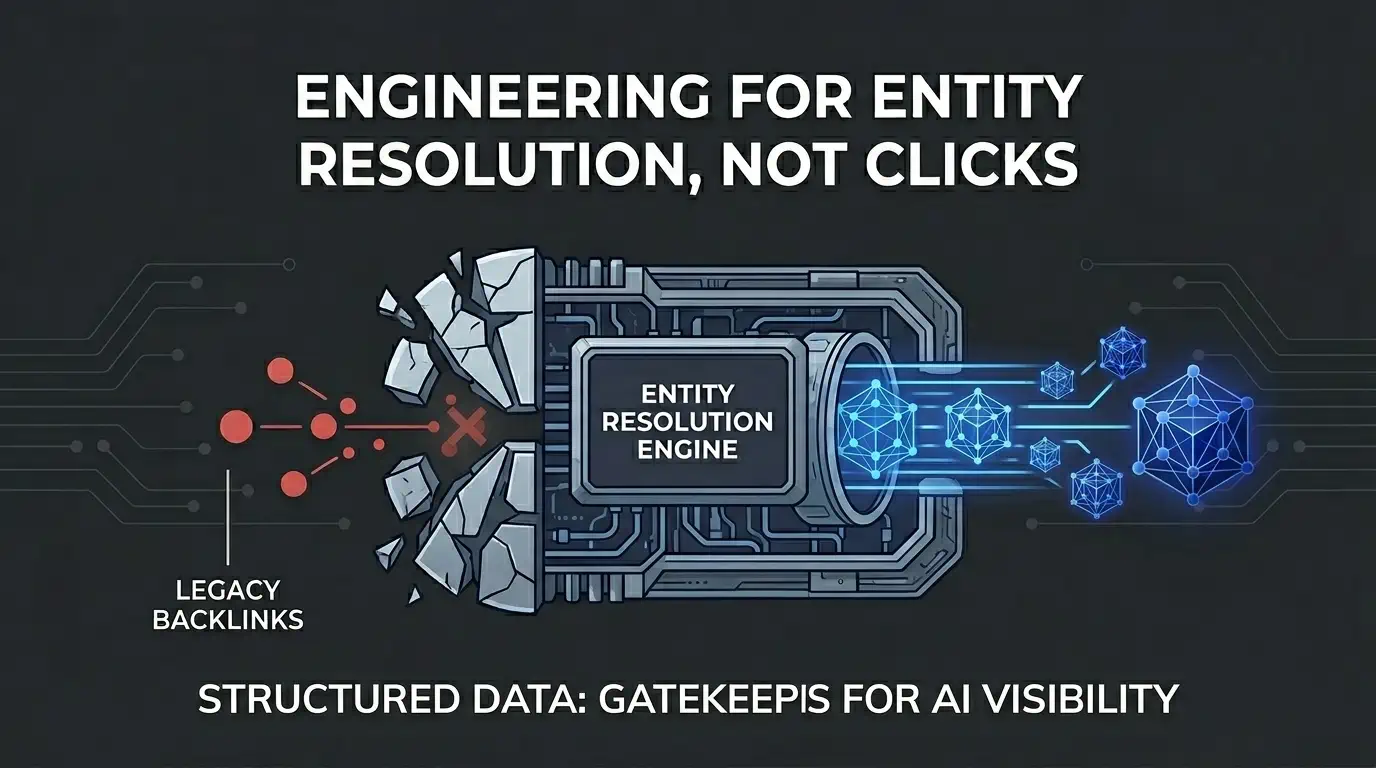
Modern AI does not “read” your pages like a human. It resolves entities. It asks: Is this a verifiable source? Is this information logically consistent with the rest of the web? If you do not have a rigid, machine-readable Entity Home, a technical framework where your business data, team, history, and solutions are mapped in a semantic graph, you do not exist to an AI agent. No amount of “guest posting” on third-rate blogs will fix a broken structural foundation. An AI agent does not care about your “Domain Authority” score. It cares about Data Integrity.
Where the “Marketers” Fall Short
Most SEO agencies are composed of marketers, not engineers. They lack the backend capabilities to build a Knowledge Graph, configure a semantic endpoint, or perform a forensic data audit. They are “quick-fix” artists in an engineering-led era. When you ask them why your leads have dried up despite “improving” your SEO, they blame the “algorithm.” The reality is they don’t know how to build for an AI-first architecture, and they hope you don’t realize their tools are tracking vanity metrics that AI simply does not care about.
I don’t care about “ranking.” I care about data integrity and systemic reliability. If your “SEO” leads to traffic but not to entity resolution, it is useless. I am not an SEO, I am an infrastructure architect.
Frequently Asked Questions and Uncomfortable Truths
It is a vanity metric they can easily inflate to look like progress. It keeps you paying the retainer while your actual entity relevance in generative engines remains flat.
No. That is human-friendly content. AI-friendly content is structured, queryable, and logically mapped. If it cannot be parsed as data, the AI treats it as noise.
Because you optimized for clicks, and AI is optimizing for answers. Every “optimization” you paid for last year made your site better for a human to scan, but potentially worse for an AI to parse.
The Critical Choice
You are currently funding your own irrelevance. If you are ready to stop chasing vanity metrics and start engineering an infrastructure that actually resolves as an authority in generative search, you need an audit, not another SEO report. It is time to treat your digital presence as an engineering asset, not a marketing expense. Request your Market Lockout status here and find out if your entity is even visible in your own vertical. When your automated processes finally collide with reality, will you have an architectural foundation to stand on, or will you be exposed as the owner of an empty, automated box?